Pages

Tuesday, October 4, 2011

web 7

When I first walked into this class I think it was safe to say that I didn’t know much of anything dealing with the digital media and social justice. From this class the most alarming and interesting information to me was on the digital divided. From the material learned in class and the input of my fellow classmates I would love to inform others on where I think the digital divided needs progression. I would also do this by taking what I have noticed before the class, such as family experiences and stories from others on digital issues. I believe it is now or never because the problem will only get worse as new generations keep popping up. This generation is all about technology and keeps pushing innovation further and further. The way I am going to explain my concerns about the digital divide dealing with social justice and digital media is clear. I am going to use digital storytelling to pass the information along so maybe more people will become aware of this growing problem.
            As I was reaching the internet for sources on the digital divide I came across some really interesting opinions and thoughts about the topic. One of the sources that I really enjoyed broke down the digital divide into 3 stages. The first stage was called the economic divide and was stated as the simplest out of the 3. To generalize the passage, it cost a lot of money to connect to the internet. They gave a fact “Dells cheapest computer costs 379 dollars.” The second stage of the digital divide was claimed to be the usability divide. The fact of the matter is that people can be given a free computer and not even know how to turn it on. I am sure we all have that older family member that hasn’t ever touched an electronic device. At the same time I am sure we all know a young child in school that hasn’t yet been taught how to work a computer. So what should we do? I think we should make the software and programs more simplistic for its new users. The third stage is the empowerment divide. This stage just shows that people have computers and only use them for certain reasons. This makes sense because in class we talked about providing and learning when it comes to the internet. Some people don’t know how to work search engines and get to valuable information that they could benefit from.
            For my story line I was going to act as if I were a person of the government trying to propose a plan to close the digital divide. In this story I plan to make valid points from my two articles that I have chosen to use for information purposes. I also will incorporate how we can use Facebook to limit the divide and other social networks.

"The Digital Divide." UC Atlas of Global Inequality. Web. 05 Oct. 2011. <http://ucatlas.ucsc.edu/communication/digitaldivide.php>.
"Digital Divide: The Three Stages (Jakob Nielsen's Alertbox)." Useit.com: Jakob Nielsen on Usability and Web Design. Web. 05 Oct. 2011. <http://www.useit.com/alertbox/digital-divide.html>.

Sunday, September 25, 2011

Web blog 6

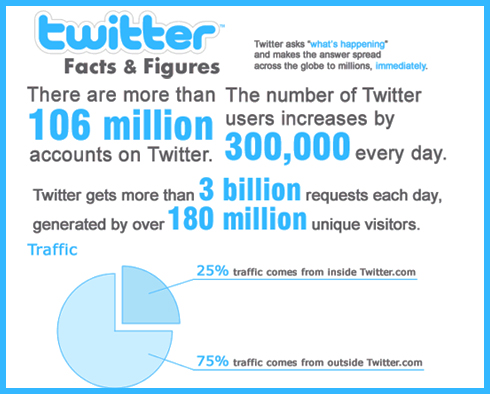
When it comes to twitter I like to think that I am a pro when using this particular social networking service. My twitter literacy is basically as high as it can possible reach. I have been a member on twitter since September 8, 2009 and obtain 280 followers. It is safe to say that twitter is evolving at rapid speeds. When I joined in 2009 i only had about 15 friends from my hometown using twitter. Today I would say about 150 of my followers are from my hometown. In my opinion I think that twitter will surpass facebook in the popularity rank among social networks. I would sum the 21st century literacy skills to be “weak.” The reason it is “weak” is because we don’t teach the future we teach the past in school and institutions. It is a bad thing when a student checks his twitter during class but in reality the youth gets its media and news from twitter. History classes should use these networking sites to pass news and knowledge. To me technology, participatory cultures, and 21st century literacy are all related in some way. I think the tech can bring cultures together to show their similarities and the literacy is the gateway between them both.


this video shows that twitter is everywhere and connects people to others peoples daily lifes.

Tuesday, September 20, 2011

web blog 5

The internet has been a huge asset in my life. I started using the internet when I was in about 4th grade. As a consumer I would say that the internet has been more than helpful in many ways and takes up multiple hours of my life day in and day out. I spend countless hours getting involved in social networking such as Facebook, MySpace, Twitter and Tumblr. Within these sites I can keep up friends, post status and engage with others’ lives. I also spend time on informational sites such as ESPN and Fox news. I use these sites for school work and just my everyday interests about what is happening in the world that day. Along with using the internet as a tool I believe that we should add to the web and make it better. People should not be selfish in the real world and with that they should not be selfish on the internet. We can create websites to help people or upload a video. Every little contribution helps in the cyber world because any progress is good progress. As far as my ICT literacy skills are concerned they most defiantly have improved over the years. When I first started I was only playing math games and now I understand how to create a blog so people can see my life and learn from me. I cannot say that I taught myself how to get this good. I have had a lot of good instructors from my sixth grade typing teacher to now my social media teacher.     


<img style="visibility:hidden;width:0px;height:0px;" border=0 width=0 height=0 src="http://c.gigcount.com/wildfire/IMP/CXNID=2000002.0NXC/bT*xJmx*PTEzMTY1NzM3Njc2NDQmcHQ9MTMxNjU3MzgxMjA*MiZwPTk3NTA3MiZkPTQyNyUyMC*lMjBBdWRpb1BhbCUyMFdpZGdl/dCZnPTEmbz*4ZjBiYTU*MTFmMTU*NWQ5YWNmYmRkNmM*Y2VlZjU*YSZvZj*w.gif" /><object height="45" width="167" type="application/x-shockwave-flash" id="audioPalPlayer" data="http://content.oddcast.com/host/audiopal/swf/workshop_player_shell.swf?mId=40813224.1&doorId=427&ds=http://host-d.oddcast.com/&playOnLoad=false">
 <param name="movie" value="http://content.oddcast.com/host/audiopal/swf/workshop_player_shell.swf?mId=40813224.1&doorId=427&ds=http://host-d.oddcast.com/&playOnLoad=false" />
 <param name="allowscriptaccess" value="always" />
 <param name="allownetworking" value="all" />
 <param name="base" value="/swf/" />
 <param name="quality" value="high" />
 <param name="bgcolor" value="#e8e9e3" />
 <param name="height" value="45" />
 <param name="width" value="167" />
 <param name="wmode" value="transparent" />
</object>

Thursday, September 15, 2011

web blog 4

After reading “Where Race Lives” I now understand why minorities feel as if the government is not giving them equal opportunities. The government stepped in to essentially give white America chances to build their wealth and style of living. This left African Americans and Latinos to a disadvantage. “The median white family had over 8 times the net worth of the median Black family. The gap is even greater for Latinos - the median white household has over 12 times the wealth of the median Latino family.” All the United States Government has done is install discrimination policies. This means nothing and will not change things at a fast rate. White people were the first to own their own business and make money. This lead to new generations of white children getting passed down to wealth and success. This chain reaction is still in effect to this day. If you do not believe this is still going on in the United States then you are living in denial. If you look at any neighborhood in the country there is a high chance that it is segregated into specific areas. Some people say that a person’s success is based on their home. This is said because the “American Dream” is owning something that you can call yours. Most people’s homes are their single biggest asset. “74 percent of whites were homeowners, while only 45 percent of Latinos, 46 percent of Blacks and 51 percent of Asians owned their homes.” The stats do not lie and you should take that into consideration.

Tuesday, September 6, 2011

web blog 3

D. Miller's lecture about social justice was very intresting. I have very little experience when dealing with social justice. After reading Ursala Le Guin's peice i now have something to compare it to. Clearly they both send different messages on what social justice really means. Both of there messages happen in life and isnt strange when it does.
         If you look at Ursala Le Guin's work it gives off a certain feel for social justice. The basics behind it stat that sometimes you have to let people to suffer or leave them out so other aspects become better. In the story the little boy who was strange so there town would remain perfect and happy. An example from the real world is dress codes at resturants. If you dont look good or fit the picture they will not let you in. this is because the resturant wants to obtain a high reputation of class.
         D. Miller's lecture tries to back up that people should make sacrifices to better the social world. He stats that society is made of independent parts and they all need to come together. Some poeple will always struggle and some people will be perfect. We cant help this because thats how our social system works. If everyone works together then we can make the world a better place.
        Both of these peices where created to give insight on social justice. I believe that there is a wrong way to look at social justice. Both of the theories happen in real life. They might not happen infront of use like on a grand scale but behind the scenes in peoples houses for example.